
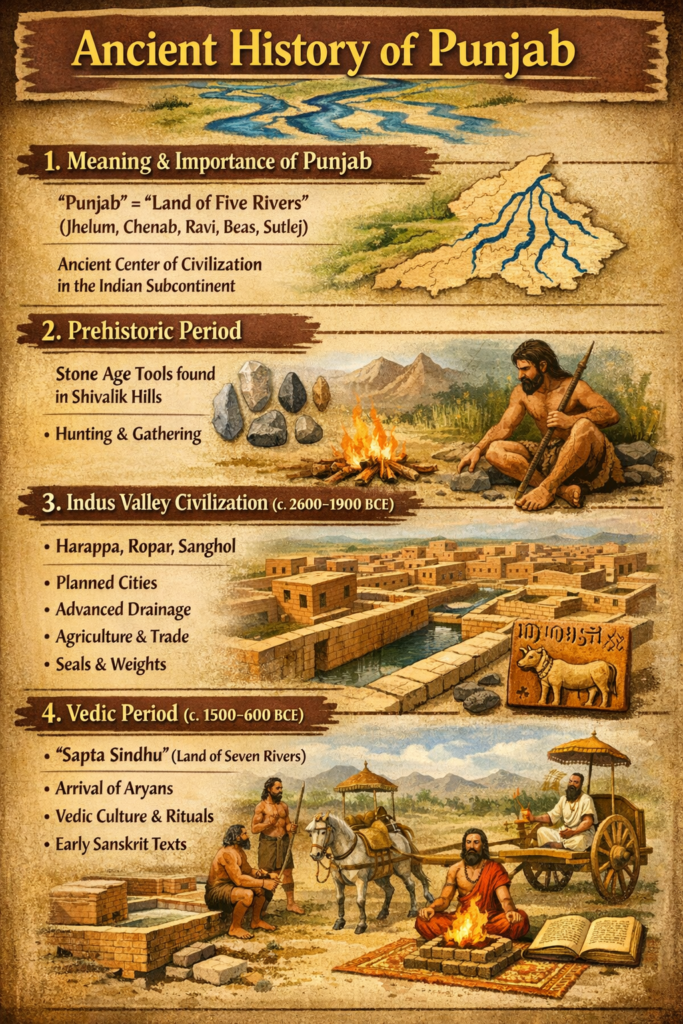
The ancient history of Punjab holds a pivotal role in the historical development of the Indian subcontinent. Traditionally, the concept of history commences with the emergence of writing, signifying the shift from prehistoric communities to civilizations that are documented historically. The period prior to written documentation is known as pre-history or proto-history, areas that are mainly explored through archaeological methods rather than through written texts.
Due to its fertile plains, extensive river systems, and its strategic position as the north-western gateway to India, Punjab has been a continuous hub of human settlement since prehistoric eras. Archaeological findings from this area indicate a gradual evolution from Stone Age cultures to metal-using proto-historic societies, ultimately culminating in the emergence of advanced urban civilizations such as the Indus Valley Civilization. This extensive historical continuum renders Punjab one of the most richly layered regions in South Asia.
Prehistoric Punjab: Stone Age Cultures in Punjab
The Stone Age Framework
The Stone Age culture in Punjab signifies the initial phase of human civilization within this area. Archaeologists categorize the Stone Age into three primary periods:
Palaeolithic Age (Old Stone Age)
Mesolithic Age (Middle Stone Age)
Neolithic Age (New Stone Age)
Every stage illustrates advancements in technology.advancement, adaptation to environment, and gradual socio-economic transformation.
Palaeolithic Age in Punjab
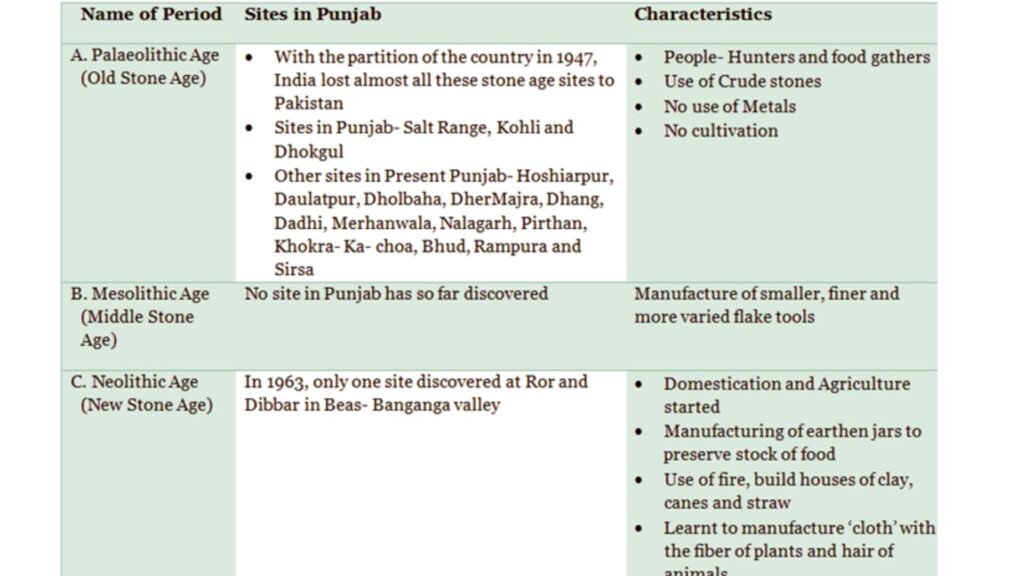
The Palaeolithic Age in Punjab began approximately 250,000 years ago and represents the earliest.The known human activities in the region during this era involved early humans who were primarily hunters and gatherers, completely reliant on nature for their survival. They lacked any understanding of agriculture, pottery, or metalworking, depending instead on rudimentary stone tools.
Archaeological findings indicate that the terrace areas of Punjab, especially locations within the Salt Range, Kohli, and Dhokgul, functioned as some of the earliest human habitats. These areas offered natural caves, reliable water sources, and a rich variety of wildlife.
Notable:- Palaeolithic sites in Indian Punjab that were uncovered post-1947 include:
- Hoshiarpur
- Dholbaha
- Dher Majra
- Nalagarh
- Rampura
- Sirsa
- Daulatpur
- Merhanwala
Studies reveal the existence of a significant prehistoric lake close to modern-day Chandigarh, which was often visited by elephants and rhinoceroses. Early humans hunted these creatures and resided in caves, showcasing their adaptive strategies for survival.
The Partition of India in 1947 led to the loss of numerous important Stone Age sites to Pakistan; however, ongoing archaeological investigations have robustly affirmed Punjab’s prehistoric heritage on the Indian side.
Mesolithic Age in Punjab
The Mesolithic Age in India is marked by the emergence of microlithic tools—smaller, sharper, and more specialized stone implements. These tools signify a shift towards more effective hunting and food-processing methods.
Nevertheless, no verified Mesolithic sites have been found in Punjab thus far. This lack of evidence continues to be a topic of academic discussion, with historians proposing either minimal habitation or inadequate archaeological investigation during this transitional period.
Neolithic Age in Punjab
The Neolithic Age signifies a transformative era in human history, distinguished by the advent of:
- Agriculture
- Domestication of animals
- Permanent settlements
- Pottery and weaving
Throughout this epoch, humans acquired the skills to cultivate crops, domesticate livestock, construct dwellings from clay and straw, and produce earthenware for the storage of food. The creation of textiles from plant fibers and animal hair illustrates early technological advancements.
In Punjab, the understanding of the Neolithic period is still quite limited. Prior to 1963, no Neolithic sites had been discovered. The unearthing of polished stone tools at Ror and Dibbar in the Beas–Banganga Valley marked the initial concrete evidence of Neolithic culture within the region.
Proto-Historic Punjab: Transition from Stone to Metal
The proto-historic era in Punjab signifies the slow evolution from the utilization of stone implements to the adoption of metals, especially copper and bronze. This period is frequently linked with the Chalcolithic and Bronze Age civilizations.
The proto-historic societies in Punjab included:
- Farmers
- Ceramic artisans
- Producers of stone, copper, and bronze tools
They developed essential technologies including the plough and the wheeled cart, resided in mud-brick dwellings, adorned themselves with metal jewelry, and farmed wheat and barley. Archaeological findings in the vicinity of Chandigarh validate the existence of Chalcolithic communities, suggesting a sophisticated rural economy prior to the onset of urbanization.
Harappan Civilization/Indus Valley Civilization in Punjab
Origin and Chronology
The Harappan Civilization, often referred to as the Indus Valley Civilization, signifies the height of proto-historic advancement in Punjab. It dates back roughly from 2500 BCE to 1750 BCE and is recognized as a Bronze Age urban civilization noted for its sophisticated town planning, uniform brick production, drainage systems, and specialized crafts.
Unearthed in 1921 by Daya Ram Sahni at Harappa, and subsequently at Mohenjo-Daro in 1922, this civilization existed prior to the arrival of the Aryans in Punjab.
Extent and Spread
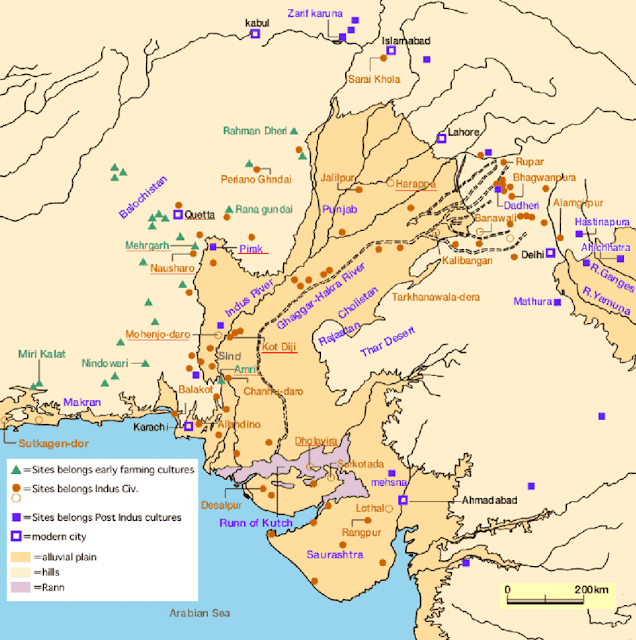
The geographical reach of the Indus Valley Civilization extended almost 1000 miles, ranging from Sutkagendor close to the Arabian Sea to Rupnagar near the Shivalik Hills. It encompassed present-day:
- Punjab
- Haryana
- Rajasthan
- Gujarat
- Sindh
- Baluchistan
- Western Uttar Pradesh
Important Harappan Sites in Punjab
Key Indus Valley sites in Punjab include:
- Rupnagar (Ropar) – Excavated by Y.D. Sharma, revealing seals, beads, pottery, and a cemetery
- Kotla Nihang Khan – Discovered in 1929
- Dher Majra – Near Rupnagar
- Bara – Late Harappan culture
- Rohira (Sangrur) – Brick houses in 1:2:4 ratio
- Sanghol – Terracotta figurines and copper objects
- Sunet (Ludhiana) – Coins, seals, moulds, and figurines
These findings confirm that Indus Valley Civilization flourished extensively in Punjab.
Coming of the Aryans to Punjab
The migration of the Aryans to Punjab around 1500 BCE coincided with the deterioration of Harappan urban centers. The Aryans traversed the north-western passes into Punjab, where they progressively founded village-based communities.
The Rigveda, recognized as the earliest text of the Aryans, was authored along the rivers of Punjab, thereby establishing the region as a spiritual and cultural hub of early Vedic civilization. Additionally, epic narratives like the Ramayana and Mahabharata illustrate Punjab’s cultural affiliations.
From a political standpoint, Punjab was segmented into tribal republics such as:
- Trigartas
- Malavas
- Kunindas
- Yaudheyas
Coins discovered at Sanghol and Rohira validate their political dominance.
Persian and Greek Invasions of Punjab
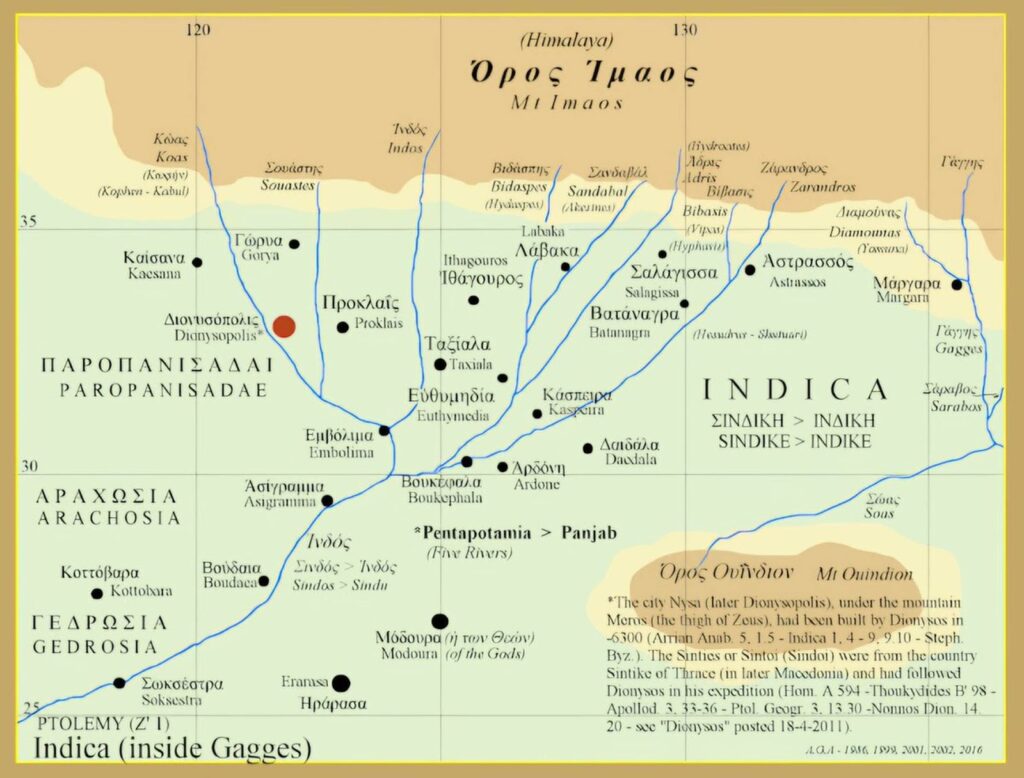
Punjab’s geographical position rendered it susceptible to external invasions. The Persians, led by Darius and Gustasp, conquered Punjab in 516 BCE, incorporating it into the Achaemenid Empire.
The Greek incursion into Punjab by Alexander in 321 BCE represented a pivotal moment in history. The renowned Battle of Hydaspes, fought between Alexander and King Porus, showcased the resilience of the Punjabi people. The establishment of Greek settlements brought forth coinage, artistic expression, and advancements in astronomy, culminating in a cultural amalgamation between Indo-Greek traditions.
Punjab under Mauryan Empire
The Mauryan Empire, established in the 4th century BCE, represented the initial political consolidation of Punjab under an Indian dynasty. Under the guidance of Chanakya, Chandragupta Maurya freed Punjab from Greek domination.
Subsequently, Punjab was incorporated into the Gandhara Province, with Takshila serving as its capital. Following the Kalinga War, Emperor Ashoka embraced Buddhism and advocated for peace, ethical conduct, and effective governance.
Post-Mauryan Punjab: Sungas to Kushans
Punjab witnessed successive rule by:
- Sungas
- Indo-Greeks
- Shakas
- Parthians
- Kushans
The Kushan ruler Kanishka (78 CE) initiated the Saka Era and expanded trade with the Roman Empire. Roman coins discovered in Punjab testify to international commerce.
Punjab under Gupta and Vardhana Dynasties
The Gupta Age (4th–6th century CE) is considered the Golden Age of Indian history. Archaeological evidence from Sunet confirms Punjab’s inclusion in the Gupta Empire.
Later, Harshavardhana of the Vardhana dynasty ruled large parts of Punjab from Thanesar. The Chinese traveler Hiuen Tsang praised the prosperity of Sirhind during this period.
Muslim Invasions and End of Ancient Punjab
The Muslim invasions of Punjab began with Mahmud of Ghazni, who defeated the Hindushahi dynasty. Despite Rajput resistance under the Chauhans, Muhammad Ghori’s victory at the Battle of Tarain (1192 CE) marked the end of ancient Punjab and the beginning of medieval rule.
Conclusion: Historical Significance of Ancient Punjab
The ancient history of Punjab reflects uninterrupted human settlement, cultural synthesis, and political transformation over millennia. From prehistoric hunter-gatherers to imperial dynasties, Punjab has played a foundational role in shaping Indian civilization.
Its archaeological richness, strategic importance, and cultural resilience continue to make Punjab a vital subject of historical scholarship.