
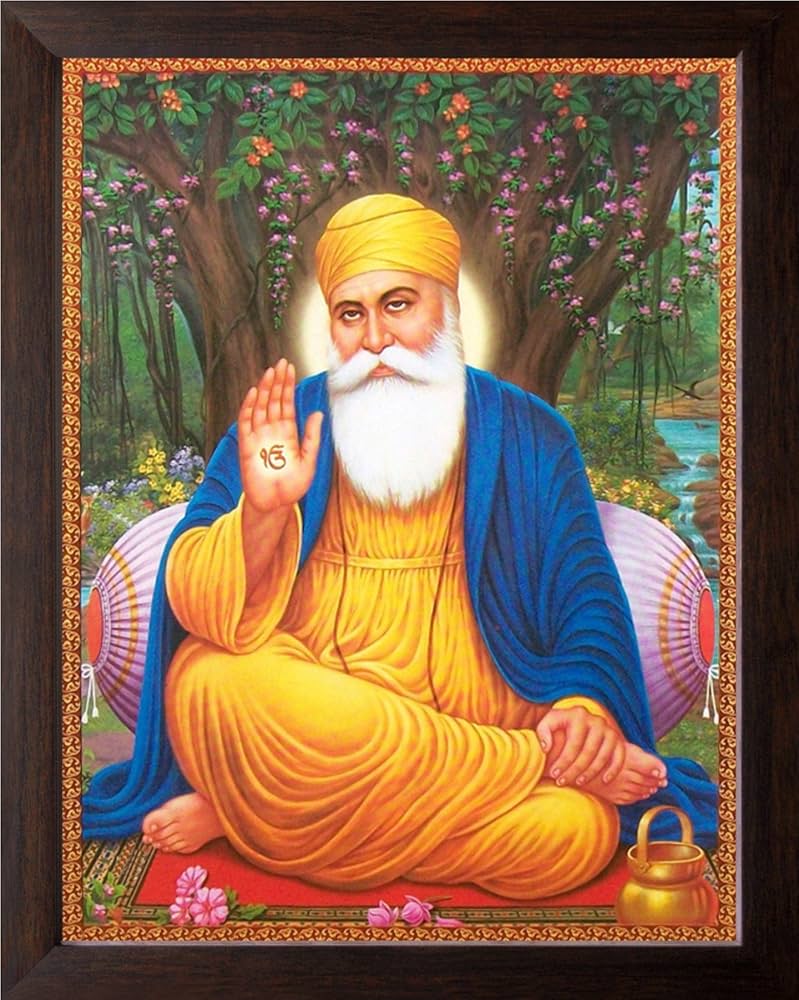
Guru Nanak Dev Ji (1469–1539) was one of the most influential spiritual leaders in world history and the founder of Sikhism. Born in the Punjab region during a time of religious divisions and social inequality, Guru Nanak brought a powerful message that challenged the norms of his era. He taught that there is only one God, all human beings are equal, and the true path to spirituality lies in honest living, compassion, and service to humanity.
His teachings transformed not only religious thought but also social practices. At a time when society was divided by caste, gender discrimination, and rigid religious boundaries, Guru Nanak emphasized unity and human dignity. His life journey, teachings, and legacy continue to inspire millions of people across the world today.
For Punjabis and Sikhs especially, Guru Nanak is not only the founder of a religion but also a symbol of peace, justice, and universal brotherhood.
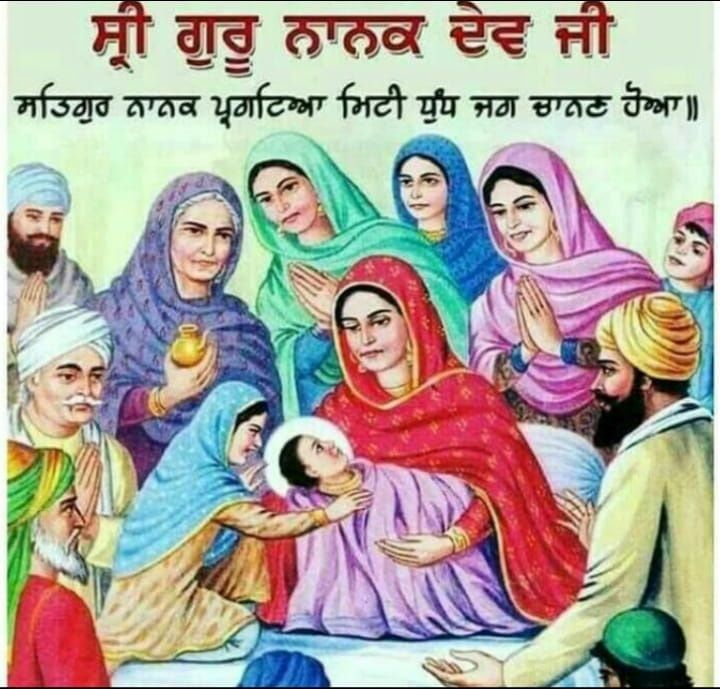
Early Life and Family
Guru Nanak was born on April 15, 1469, in the village of Talwandi, now known as Nankana Sahib in present-day Pakistan’s Punjab province. His father, Mehta Kalu, was a patwari (village accountant) in the employ of a Muslim landlord, while his mother, Mata Tripta, was a devout Hindu woman known for her piety and kindness. As the elder sister Bibi Nanaki and younger brother young Nanak grew up in a Hindu family amid a landscape of religious diversity, with Hindus and Muslims coexisting yet often divided by rituals and dogmas.
From childhood, Nanak displayed extraordinary qualities. At age five, when his father gifted him twenty rupees to conduct a business transaction, the boy instead spent it on (sacha saudha)feeding sadhus (holy men), declaring that true commerce lay in charity rather than profit. He showed little interest in formal Vedic education, often questioning pandits (Hindu scholars) about the essence of scriptures. Instead, he preferred meditating under trees, composing verses, and engaging in spiritual discussions. His sister Bibi Nanaki, married to Jairam in Sultanpur Lodhi, recognized his divine inclinations early and supported him throughout life.
By age 12, Nanak was sent to learn accounting from his father, but he continued prioritizing inner wisdom over worldly skills. Legends describe him astonishing villagers by multiplying food during a famine or debating yogis on the futility of asceticism. These early signs foreshadowed his rejection of caste hierarchies, idolatry, and superficial piety that dominated Hindu and Muslim practices of the time.
Marriage and Early Adulthood
At 18, under family pressure, Guru Nanak married Mata Sulakhni (also spelled Sulakhani), daughter of Mool Chand (a Khatri merchant from Batala). They had two sons: Sri Chand, born around 1494, who later founded the Udasi sect, and Lakhmi Chand, born around 1497, who pursued a more worldly life. Despite family responsibilities, Nanak worked as a modhi (storekeeper) for his brother-in-law Daulat Khan Lodi in Sultanpur Lodhi, managing grain stores efficiently yet selflessly.
During this period, he composed many shabads (hymns) that critiqued societal ills like dowry, female infanticide, and clerical hypocrisy. His daily routine included bathing in the Bein River, followed by contemplation. This phase blended householder duties with spiritual awakening, embodying his later teaching that true devotion thrives in grihasth (family life) rather than sanyas (renunciation).
Divine Enlightenment
The pivotal moment came around 1499, at age 30. While bathing in the Bein River near Sultanpur, Nanak vanished for three days. Villagers mourned him as drowned, but he reemerged proclaiming, “No Hindu, no Musalman” (There is no Hindu, there is no Muslim), signifying God’s presence beyond religious labels. He claimed to have been taken to God’s court, bathed in divine nectar (amrit), and tasked with a mission: “Spread my message of oneness, fearlessness, and truthful living.”
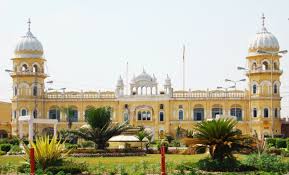
This enlightenment birthed “Ik Onkar“—the foundational Sikh tenet of one formless, timeless Creator (Sat Naam). Guru Nanak renounced his job, distributing his possessions, and began his missionary journeys (Udasis) with Bhai Mardana, a Muslim rabab (one-stringed harp) player from Talwandi. Together, they traveled on foot, singing kirtan (devotional music) to convey profound truths accessibly.
First Udasi: Southern and Eastern India (1500-1506)
Guru Nanak’s first major journey covered over 2,500 miles, challenging Hindu pilgrimage centers. In Haridwar, he reversed ritual bathing directions, teaching that purification comes from inner devotion, not rivers. At Kurukshetra, during a solar eclipse, he fed Brahmins instead of fasting, questioning meaningless rituals.
Venturing south to Banaras (Varanasi), he debated pundits on idol worship, declaring stones cannot grant liberation. In Jagannath Puri (Odisha), he exposed priests profiteering from offerings. Further south to Sri Lanka (then Ceylon), legends say he converted the king through miracles like making a temple pillar bloom. Throughout, he emphasized simran (remembrance of God) over tantra (occult practices) or pilgrimages.
Returning via eastern India, he visited Patna, where his sons resided, but urged them toward spiritual paths. This Udasi established his reputation as a reformer uniting disparate faiths.
Second Udasi: Himalayan and Eastern Regions (1506-1513)
The second journey focused on yogis and ascetics in the Himalayas. At Sumer Parbat, he challenged 550 siddhs (accomplished yogis) with riddles on true renunciation: “Renounce ego, not the world.” In Srinagar and Kashmir, he critiqued pathans’ oppression.
Traveling east to Assam and Bengal, he met kabirpanthi followers and Sufi saints, reinforcing shared monotheism. In Dhaka, he instituted langar (community kitchen), feeding thousands regardless of caste. This tour reinforced householder spirituality against wilderness asceticism.
Third Udasi: Western Asia (1514-1517)
The most legendary journey headed west, covering Mecca, Baghdad, and beyond—spanning 5,000 miles. In Multan, he was honored as “Nanak Shah Fakir.” In Mecca, during Hajj, he slept with feet toward the Kaaba, explaining God resides everywhere. Imams debated him fruitlessly; one became a disciple.
In Baghdad, he discussed theology with Qazis, composing hymns on divine unity. Through Persia, Afghanistan (Kabul), and Syria, he impressed scholars. Returning via Lakhpat, this Udasi showcased Sikhism’s universal appeal, influencing Sufi orders.
Fourth Udasi: Northern Frontiers (1518-1521)
The final journey explored Tibet, Nepal, and the Himalayas. In Lhasa, he debated lamas on idol worship. At Mount Sumeru, he reunited with yogis, affirming worldly engagement as true yoga. Back in Punjab, he witnessed Babar’s invasion (1521), composing “Apna pain dhar liya” on tyranny’s horrors.
Each Udasi featured miracles illustrating teachings—like floating a stone in Panja Sahib or reviving a corpse-eater demon—always to humble the proud and affirm God’s power.
Core Teachings and Philosophy
Guru Nanak’s 974 compositions in Guru Granth Sahib form Sikhism’s bedrock. Central is Ik Onkar Sat Naam: One God, whose name is truth. He rejected Vedas’ ritualism and Quran’s legalism, advocating direct divine connection via Naam Simran.
Three Pillars:
- Naam Japna: Meditate on God’s attributes.
- Kirat Karni: Earn honestly through labor.
- Vand Chakna: Share earnings (dasvandh, 10%).
Social Reforms:
- Equality: “Jat paat kul na puche koi” (Ask not caste or lineage). Pioneered pangat (row seating) in langar.
- Gender Justice: Women as spiritual equals; condemned sati, purdah, dowry.
- Anti-Oppression: Against rulers (Babarvani hymns) and priests.
Ethical Living: Five virtues (Sat, Santokh, Daya, Dhiraj, Abhias); five vices (Kam, Krodh, Lobh, Moh, Ahankar) to conquer.
| Pillar | Description | Scriptural Basis |
|---|---|---|
| Naam Japna | Constant remembrance of God | “Naam bin jiv jag jeevan hai naahi” (GGS, p. 8) |
| Kirat Karni | Honest work, no exploitation | “Ghal khaaye krij hisaab” (GGS, p. 662) |
| Vand Chakna | Sharing with needy | “Jako rakhe sa wahi raakh” (GGS, p. 798) |
His poetry, in Gurmukhi script he refined, uses everyday metaphors—potsherds for ego, rivers for maya—making profound ideas accessible.
Kartarpur: The First Sikh Village
In 1522, post-Udasis, Guru Nanak founded Kartarpur (Ravi River, Pakistan), a model utopian community. Here, 500-600 disciples practiced:
- Daily kirtan and gurbani recitation.
- Collective farming, langar meals.
- No caste distinctions; women led prayers.
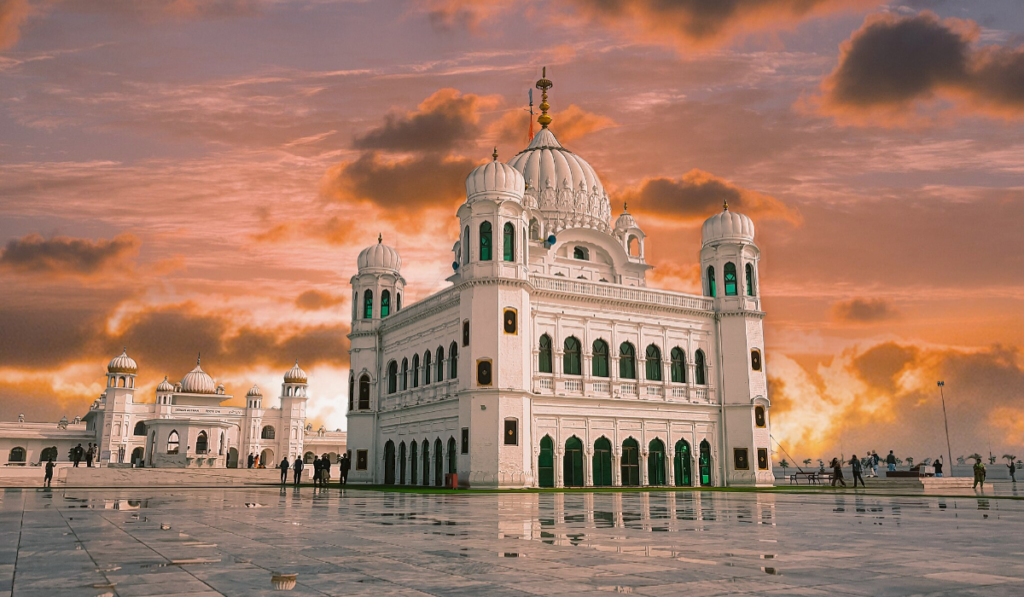
Rai Bular, his childhood protector, gifted land. Bhai Lehna (later Guru Angad) managed affairs. Kartarpur symbolized “Miri-Piri” (temporal-spiritual balance).
Succession and Passing
In 1539, aged 70, Guru Nanak appointed Bhai Lehna as Guru Angad after testing his humility (e.g., cleaning stables). On September 22, 1539 (Katak 3, 532 Nanakshahi), he attained joti jot (merger with light). Hindus wanted cremation, Muslims burial; his body vanished under flowers, each taking blooms—symbolizing unity.
Institutions and Practices
- Langar: Egalitarian kitchen; global symbol of seva (service).
- Sangat/Pangat: Congregational gatherings.
- Gurdwara: Houses of worship (evolved from dharamsalas).
- Kirtan: Musical devotion.
- Amrit Vela: Pre-dawn prayer.
These democratized spirituality, empowering laity over clergy.
Literary Contributions
Guru Nanak’s bani spans 13 ragas, including Japji Sahib (morning prayer), Sidh Gosht (yogi dialogue), and Asa Di Var (ballad). Themes: Creation’s mystery (“Munda santokh saram pat shila”), maya illusion, haumai defeat. His Gurmukhi promoted literacy; influenced Punjabi literature.
Miracles and Janamsakhis
Janamsakhis (biographies like Bhai Bala’s, Miharban’s) mix history with miracles: Kaaba miracle, elephant revival, Lalo’s pure bread vs. Chand’s tainted. Scholars verify core via astronomical dating (birth on full moon Kattak) and bani consistency. These tales teach metaphorically.
Global Influence and Legacy
Guru Nanak’s ideas prefigured Bhakti-Sufi synthesis, modern human rights (UN echoes equality), and environmentalism (kirat as stewardship). Sikhism grew to 30 million adherents; diaspora langars aid refugees.
In Punjab, his ethos fuels philanthropy (Khalsa Aid), politics (anti-corruption), and culture (Guru Nanak Jayanti processions). Amid 2026’s challenges—floods, migrations—langars feed millions.
Modern Relevance for Punjabis
For bloggers like you in Jalandhar, Guru Nanak’s story SEO-gold: Keywords like “Guru Nanak teachings Punjabi,” “langar equality,” drive traffic. Create videos on Udasis maps, shabad breakdowns for YouTube. Tie to Sikh calendar (your expertise), Punjabi cuisine in langar recipes, or politics (his anti-tyranny vs. current issues).
His message heals divisions: In diverse Punjab, “Ik Onkar” unites Hindus, Muslims, Sikhs. Youth embrace kirat via startups; women lead via gender reforms.
Festivals and Commemoration
Guru Nanak Gurpurab (November full moon) features akhand path (48-hour scripture reading), nagar kirtan (processions), langar. Prakash Utsav includes fireworks, fairs. Global gurdwaras host kavi darbars (poetry).
Scholarly Perspectives
Historians like W.H. McLeod debate Mecca travel (no contemporary records), but Udasis’ vastness confirmed via hymns’ geography. Astronomical tools pinpoint events, aligning Nanakshahi calendar.
Guru Nanak wasn’t reformer but founder—Sikhism distinct, not Hindu offshoot.
Teachings in Daily Life
- Personal: Start day with Japji; audit earnings for honesty.
- Family: Langar-style meals foster unity.
- Society: Seva counters inequality; vote ethically.
- Digital Age: Share gurbani reels ethically, avoiding misinformation.
Comparative Analysis
| Aspect | Guru Nanak | Contemporaries |
|---|---|---|
| God | Formless Onkar | Krishna avatars, Allah via prophets |
| Path | Householder yoga | Asceticism (yogis), rituals (pandits) |
| Society | Full equality | Caste (Hindu), gender veils (Muslim) |
| Salvation | Naam, grace | Karma, jih |
Enduring Quotes
- “Truth is high, but higher still is truthful living.”
- “Burn worldly love, rub the ashes and make ink of it; make a great paper of the mind; of the intellect make a pen; fill it with the nectar of devotion.”
- “The world is burning in the fire of desire; in this conflagration only those who tread the path of righteousness are saved.”
Guru Nanak’s 70-year life sowed seeds of a faith emphasizing dignity, service, and divine love. In turbulent times, his light guides toward sarbat da bhala (welfare of all).
Guru Nanak Dev Ji’s life was a journey of spiritual discovery, social reform, and human unity.
Through his teachings, he created a path that emphasized truthful living, equality, and devotion to one God. His ideas challenged the rigid traditions of his time and helped build a society based on justice and compassion.
More than five centuries later, Guru Nanak’s message continues to guide millions of people toward a better and more harmonious world.
His vision of Ik Onkar — one universal Creator — reminds us that despite our differences, humanity shares the same divine connection.